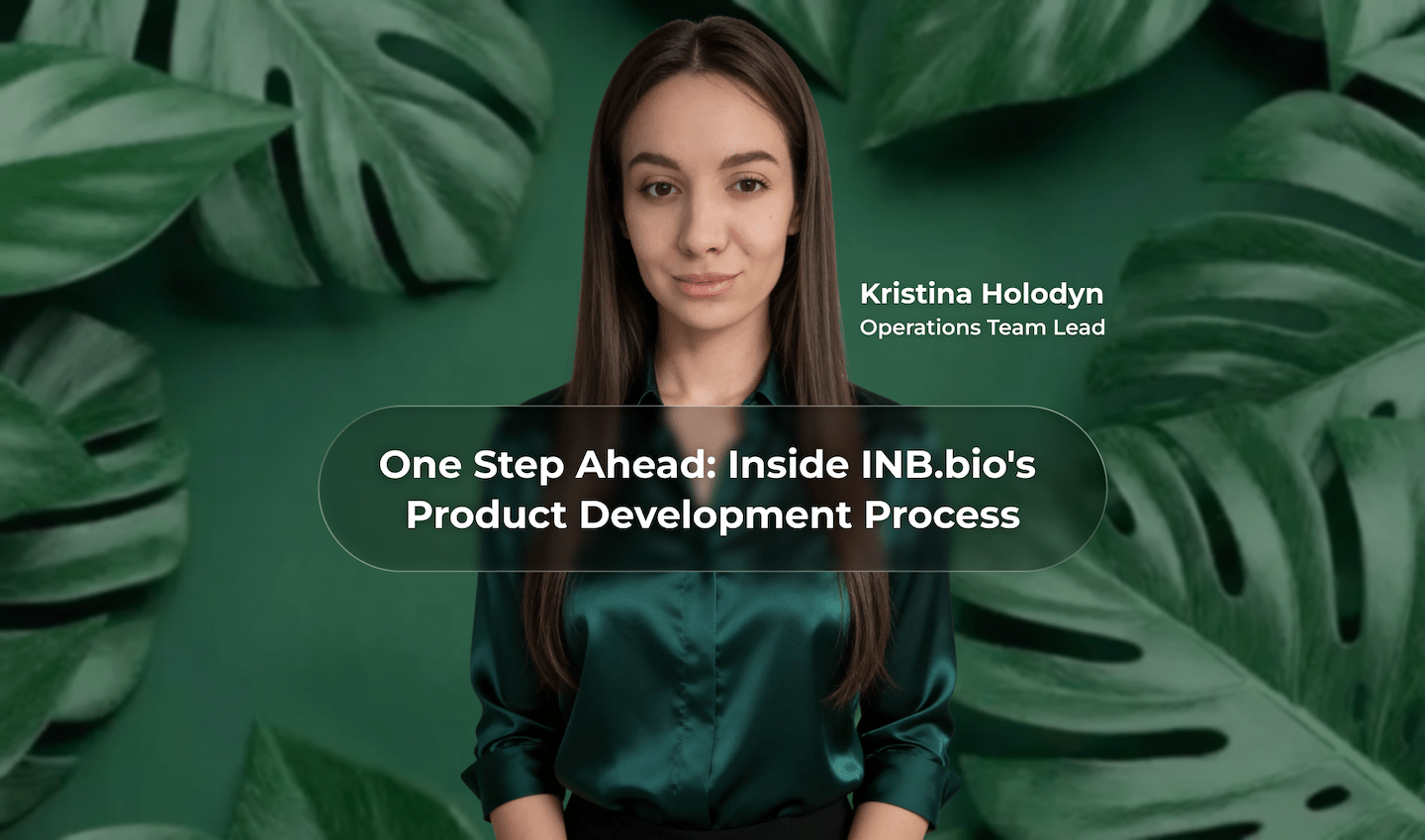
There’s a certain type of person in every company. Not the one with the flashiest title. The one who, when something is quietly or loudly going wrong, can solve the issue. At INB.bio, that person is Kristina Holodyn.
Her official title is Operations Manager. Her unofficial title is “the person who can put out any fire.” She joined the team in April 2023, and since then she’s been the person who watches every moving part of the machine: the GEO processes, the CRM performance, the sales teams, the delivery chains.
But today we’re here to talk about something that happens long before operations even get involved, the moment a product is born.
Step One: Watch What Rich People Are Buying
Kristina has a theory, and it’s a good one.
“The markets we operate in are developing fast,” she says, “but there’s always a lag between what becomes mainstream in Europe and when it arrives in our GEOs. That lag is the window.”
Translation: if London is obsessed with a new collagen format today, Kenya will be looking for it in eighteen months. And INB.bio intends to already be there, stocked and ready, before any competitor has even booked their flight.
This is how the product development process starts but with someone paying close attention to what’s trending in developed markets and asking a simple question: when does this arrive in ours, and can we get there first? It sounds almost unfairly straightforward. It works.
Step Two: Ask the People Who Actually Know
Here’s where most companies get it wrong. They do the global trend analysis, feel very clever about themselves, and then launch a product that the local audience greets with complete indifference.
INB.bio does it differently.
After identifying a promising direction, the team goes deep on specific GEO research and crucially, that research includes talking to affiliate partners who run traffic in those markets daily. These are people who hear customer objections in real time, who know which claims convert and which ones make people hang up the phone.
“We’ve had situations where partner feedback completely changed the positioning of a product before launch,” Kristina says. “Not the formula, the way we talk about it. The benefits we lead with. The audience we target.”
A launch without that input, she adds, is just a guess. And INB.bio doesn’t really do guesses.
Step Three: Have a Difficult Conversation With a Laboratory
Now comes the part where optimism meets chemistry.
The team takes its well-researched, partner-validated, trend-backed product idea to the lab and asks: can we actually make this? To spec, to quality standard, to regulatory requirement?
Sometimes the answer is yes. Sometimes it’s “yes, but not here.” And sometimes it’s a polite scientific way of saying “absolutely not.”
INB.bio’s response to the third option? Find another way.
“The production location is never what stops a launch,” Kristina explains. “What matters is that the final product meets our requirements and closes a real need in the market. We’ll look at alternative facilities, import options, and reformulation. The goal stays the same. We just adjust the path.”
The goal, notably, is often to introduce something that doesn’t yet exist in the target GEO – a product that fits where the market is going. Which means they’re shaping what the shelf looks like.
Step Four: Do Not Skip the Pilot. Do Not.
Here is Kristina’s face when someone suggests skipping the pilot launch to move faster: 🤦♀️. Reader, she does not look pleased.
“Data tells you what should happen,” she says. “A pilot tells you what actually happens.”
And those two things, she has learned, can be surprisingly different.
Every INB.bio product enters the market through the same gate: small batches, controlled scaling, rigorous tracking of buyout rates, returns, and partner feedback. The pilot is where hidden problems surface while the cost of fixing them is still manageable.
Skipping it to go faster, as Kristina puts it, is “a false economy.” You save a few weeks. You risk a few months.
Only when the numbers are stable: buyout holding, returns low, partners not sending urgent messages at midnight, does the product move to full rollout.
Step Five: Scale With Intent
When the pilot confirms what the research predicted, INB.bio activates the full machine. Local production supply. Trained call center operators. Delivery infrastructure. The whole turnkey setup that means a partner can send traffic and trust that something solid is waiting on the other end to catch it.
This is what separates the model from a simple affiliate program: by the time a partner sees an offer, INB.bio has already solved the operational problems so they don’t have to.
The Part Where We Land the Plane
So what does Kristina actually do in all of this? She’s the person who makes sure that:
- the process doesn’t just exist on paper;
- the research phase actually informs the product;
- the lab findings actually change the plan when needed;
- the pilot metrics are actually read and acted on.
She’s been in the affiliate and operations world long enough to know that the gap between “we have a process” and “the process works” is filled entirely by people who care whether it does. She is, clearly, one of those people and we are happy to have her.