We use cookies to personalize content, improve site performance, and analyze traffic. We also share information about your site usage with our advertising and analytics partners. They may combine it with other data you have provided or that they have collected from your use of their services.
Customize
INB Team
March 19, 2026


Six years, 15 countries, and more lessons learned the expensive way than anyone wants to admit
Most founder stories follow a script. There’s the origin moment, the hockey-stick growth, the challenges overcome with determination and vision. Everything points upward and to the right.
Rozhden Totskoinov’s story doesn’t work like that.
In six years, INB.bio has opened and closed countries multiple times. We have survived tracking systems that confidently lied, couriers who invented their own schedules, a CEO who sued us before we launched. We have rebuilt their tech stack from scratch, relaunched products that flopped, and learned the difference between speaking a language and understanding a conversation.
Today, INB.bio operates as a direct advertiser across 15+ countries in Africa, MENA, and Latin America, employs 400+ people, and runs 50+ exclusive dietary and wellness products through infrastructure they built themselves. Native call centers. Owned logistics. Proprietary tech platforms.
We sat down with Rozhden to talk about what it actually takes to build a company in markets most competitors won’t touch, why failure is a feature not a bug, and what happens when your tracking system develops a personality disorder.
You launched INB.bio six years ago. What was the original plan?
The plan was straightforward: sell wellness products in underserved markets where global brands hadn’t built infrastructure. Africa, MENA, Latin America. Markets with growing populations, mobile-first behavior, real demand for health products, and almost no one serving them properly.
The assumption was that if we could just get products there and set up basic operations, it would work. That assumption was… incomplete.
What did you get wrong?
Everything about what “basic operations” actually meant.
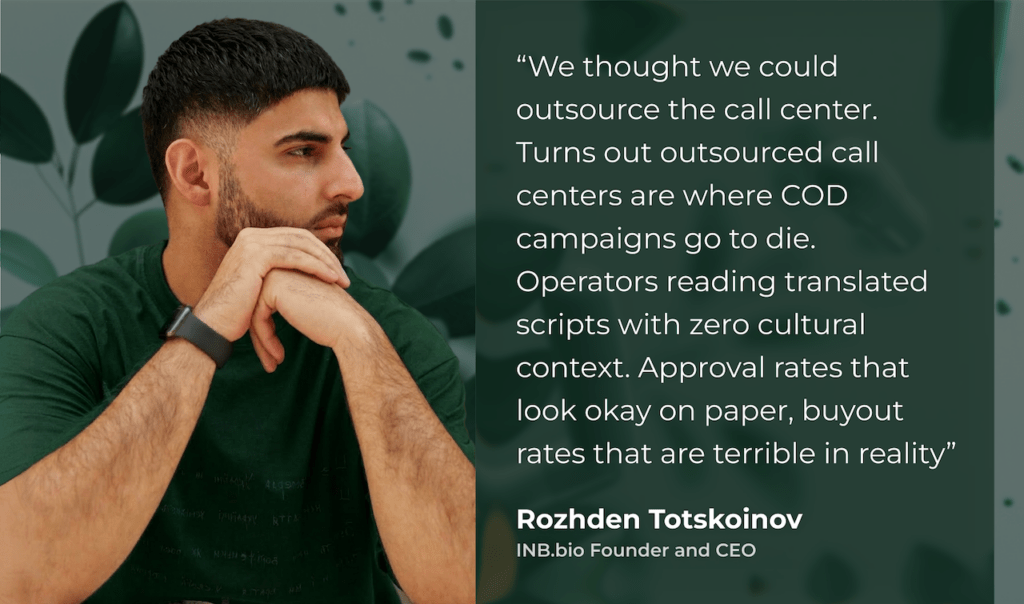
We thought we could outsource the call center. Turns out outsourced call centers are where COD campaigns go to die. Operators reading translated scripts with zero cultural context. Approval rates that look okay on paper, buyout rates that are terrible in reality.
We thought logistics was just finding a courier partner and letting them handle it. Turns out in markets where addressing systems don’t really exist and delivery infrastructure is developing, “just find a partner” is not a plan.
We thought we could launch with generic products and adapt them later. Turns out “later” means “after you’ve already failed and spent the money.”
The original plan wasn’t wrong about the opportunity. It was wrong about what executing on that opportunity would require.
Your team talks about a tracking system that reported packages as delivered while they were still in vans. What happened?
(Laughs) That was year one. We had built a tracking system. It worked in the sense that it turned on and showed information. It did not work in the sense of showing accurate information.
Customers would call asking where their package was. We’d check the system. The system would say “delivered.” The customer would say “no it’s not.” We’d call the courier. The courier would say “yeah I still have it, I’m at lunch.”
The system was just… wrong. Confidently wrong. It had no idea it was wrong.
How long did this go on?
Weeks. It went on for weeks.
Evgeniy, our CTO, describes this period as “formative.” Everyone else describes it differently.
What did you do?
Evgeniy rebuilt everything. Not patched it. Rebuilt it. The entire tech stack. CRM, delivery platform, database architecture, all of it.
It was expensive and it took time and it was the right decision. You can’t scale a business when your fundamental systems are lying to you about reality.

Egypt opened and closed three times. Why?
The first time we didn’t have the operational model figured out. The second time we thought we’d fixed it but we hadn’t. The third time we actually fixed it and then realized the issue wasn’t the operation, it was the local partnership structure.
By the time we closed it the third time, we’d learned the lesson we should have learned after the first: if the fundamentals don’t work, scaling doesn’t fix them. It makes them worse faster.
Did you consider a fourth attempt?
No. There’s a difference between persistence and not learning from your mistakes. We learned.
Some markets aren’t ready when you want them to be ready. Some partnerships don’t work no matter how much you want them to. Egypt taught us that walking away is sometimes the right move.
What’s the criteria now for whether to stay in a market or cut losses?
Can we fix the fundamental problem, and is fixing it worth the cost?
If the answer to both is yes, we stay and fix it. If the answer to either is no, we cut losses and move on. We don’t do Egypt 4.0 anymore.
Venezuela took 18 months and 1,116 pages of certification documents before it worked. How did you not give up?
We almost did. Multiple times.
Every month someone would ask “should we just stop?” And every month we’d look at the investment we’d already made and the market opportunity and decide to keep going.
It was a sunk cost fallacy except it turned out the cost wasn’t actually sunk, it was an investment that eventually paid off.
What changed in 2025?
We finally got through all the regulatory requirements, the team figured out the operational rhythm, and the market opened up. Venezuela went from “why are we doing this” to one of our top-performing GEOs.
What did you learn?
That bureaucracy in emerging markets is the operating system. You can’t go around it. You have to go through it. And going through it takes longer than you think and costs more than you budgeted.
If you’re not willing to spend 18 months navigating paperwork, don’t enter these markets.

You hired a CEO in Zambia who sued you for $400,000 before you’d made a single sale. How does that happen?
We hired someone local to run operations. We rented an office, hired two operators, set everything up. We were one day from launching.
The CEO decided we, the parent company, didn’t know what we were doing. He sued us to take control and “better manage” the investment.
What was his logic?
He saw the money we’d invested in opening the market and thought it was profit. He wanted control of it.
We had an office and two people. No revenue. No operations running yet. But he saw investment capital and thought “that should be mine.”
What did you do?
We hired lawyers. Spent about a quarter of our opening budget on legal fees. Eventually realized we were going to spend more fighting this than we’d spent opening the market.
We walked away. Zambia never happened.
What’s the lesson?
That some people see “investment” and think “profit I can control.” You have to screen for that before you give someone an entire country operation.
Also, sometimes cutting your losses early is cheaper than being right.
Your Venezuela team worked through a presidential kidnapping. What happened?
The president got kidnapped. For three hours, the whole country went into chaos. Our operations went dark.
Most companies would have folded. Our team came back online in 36 hours. Full operation. Zero data lost.
Why did you come back that fast?
Because we have real infrastructure there. Real people. Real operations. When the crisis hit, our team handled it because they were there and they knew what to do.
Other companies with “Venezuelan operations” that were actually just outsourced call centers somewhere else? Still looking for their operators. Still down. Still not sure what happened.
What does that prove?
That you can’t fake infrastructure. When a country goes into crisis mode, you find out very quickly who actually has operations on the ground and who’s just routing calls through a third party.
We have people in Venezuela. When the country had a crisis, they handled it. That’s the difference.

You launched a product where every metric said it would work, and it didn’t. What happened?
We had data showing demand. We had a product that worked in other markets. We had native operators who spoke the language perfectly. We had a script that was technically flawless.
We launched. It flopped. We knew the language. We hadn’t learned the conversation.
The way people in that market talked during sales calls, the rhythm, the pauses, the questions underneath the questions, the moment where trust either forms or doesn’t, we hadn’t understood any of that.
The operators were following the script perfectly. The script was written for a different cultural context.
What did you do?
Iryna, our Head of QC, listened to hundreds of calls. We rebuilt the entire approach. Not just the script — the understanding of what the conversation was actually about.
Three months later we relaunched. It became a top performer.
What’s the lesson?
Speaking the language is step one. Understanding how people actually communicate in that market, what they mean versus what they say, what builds trust, what kills it, that’s the actual job.
You can’t translate your way into cultural understanding. You have to learn it.
Six years in, what does success look like from where you’re sitting?
Success is that we’re still here and we learned from the things that broke.
We have 400 people across 15 countries who know what they’re doing. We have tech that works. We have markets that perform. We have partners who trust us because we’ve proven we can deliver.
But mostly success is that we stopped making the same mistakes over and over. We still make mistakes. New ones. But we document them, we fix them, and we don’t repeat them.
What are you most proud of?
That we built real infrastructure in markets where most companies won’t even try.
Pakistan, Tanzania, Venezuela, Morocco, Algeria. Markets where the operational complexity is real and you can’t fake it. We’re there. We have people. We have systems. It works.
When a partner asks “do you really have operations there or is this outsourced,” we can show them. Call center address. Warehouse location. Courier team. Delivery SLAs. The whole thing.
We’re proud that we built it for real instead of building a good-looking version that doesn’t work when tested.
What are you building toward?
We want to be the wellness infrastructure in emerging markets.
The actual infrastructure that makes wellness accessible in markets where it historically hasn’t been.
Right now we’re in 15 countries. We’re launching Tanzania in Q1. We have three to five more markets planned for 2026. We’re rebuilding the affiliate CRM from scratch. We’re expanding the product line to 70+ SKUs.
But the bigger vision is that when someone in Dar es Salaam or Karachi or Caracas wants a wellness product, INB.bio is how they get it. The call center that understands them. The logistics that work. The product that’s adapted for them.
We want to build that across 30, 40, 50 countries. Markets that need it and that nobody else is serving properly.
What’s the biggest risk to that vision?
That we stop learning from mistakes. That we start thinking we’ve figured it out and stop being willing to admit when something’s broken.
The moment we become the kind of company that doesn’t fix things because “that’s how we’ve always done it,” we’re done.
As long as we’re willing to say “this isn’t working, let’s rebuild it,” we’ll be fine.
What would you tell someone who wants to build a business in these markets?
Be willing to find out what you don’t know. And then actually do something about it.
Everyone comes in thinking they understand the market because they read reports and talked to people. Then they hit the ground and realize the reports were wrong and the people were being polite.
Your tracking system will lie. Your first hire will be wrong. Your script won’t work. Your logistics will break. Your assumptions about what customers want will be incomplete.
That’s normal. That’s the process.
The question is whether you’re willing to fix those things when they break or whether you’ll blame the market and leave.
How do you know which problems are worth fixing versus which markets to exit?
If the problem is operational, something in your control that you can fix, fix it.
If the problem is structural, something about the market fundamentally not being ready or the partnership not working, exit fast.
We spent 18 months fixing Venezuela’s regulatory problems because that was solvable. We walked away from Zambia’s CEO lawsuit because that wasn’t.
Any final advice?
Build for real or don’t build at all.
You can’t fake infrastructure in these markets. When things break, and they will break, you find out very fast whether you built something real or whether you built something that looks good in a pitch deck.
Build the real thing. It’s harder and more expensive and takes longer. But it’s the only thing that works.