We use cookies to personalize content, improve site performance, and analyze traffic. We also share information about your site usage with our advertising and analytics partners. They may combine it with other data you have provided or that they have collected from your use of their services.
Customize


INB Team
March 10, 2026


Picking the wrong direct nutra advertiser partner doesn’t announce itself upfront. It reveals itself slowly in approval rates that don’t match what was promised, in payments that arrive late without explanation, in call centers that can’t handle the traffic you’re sending, in GEOs that turn out to have none of the infrastructure you were told they had. By the time the damage is visible, you’ve already spent the budget.
This guide explains how to identify advertiser partners worth scaling with. It also offers a practical framework to evaluate them before sending any traffic.
In tier-1 Western markets, a weak advertiser partner is an inconvenience. You rotate to another offer, take the short-term hit, and move on.
In emerging markets, across Africa (Kenya, Rwanda), MENA (Morocco, Algeria, Tunisia), Latin America (Venezuela), the stakes are higher. GEOs in these regions require real on-the-ground infrastructure:
An advertiser without that infrastructure wastes every lead you send and makes the market look like it doesn’t convert, a conclusion that follows your campaign planning long after you’ve moved on from that partner.

The most common red flag is an advertiser claiming to “cover” markets they don’t actually operate in. In a COD market, coverage means a warehouse, a native call center, and a working delivery network.
Ask these questions before signing anything:
A legitimate direct advertiser answers these specifically and immediately. One without real infrastructure deflects or generalizes.
Approval rate measures whether a customer said yes on the phone. Buyout rate measures whether they actually paid at the door. In COD markets, the second number is the one that determines your revenue.
| Metric | What it measures | Why it matters |
| Approval rate | Customer confirmed purchase on call | Indicates call center performance |
| Buyout rate | Customer paid at delivery | Indicates actual revenue collected |
| Return rate | Orders rejected or returned | Indicates lead quality and delivery reliability |
An advertiser who leads with approval rate and doesn’t readily share buyout data by GEO is either hiding underperformance or lacks the operational depth to track it. Neither is a partner worth scaling with.
Late payments in affiliate marketing are rarely one-off administrative issues. They are a pattern. An advertiser with cash flow problems or poor financial management will be late repeatedly, with increasingly creative explanations each time.
An advertiser pushing you to increase volume before the existing traffic is converting at acceptable rates is prioritizing their short-term revenue over your campaign health.
“We’ve seen partners get pushed to send more volume before the fundamentals were right,” says Yurii Abramchuk, Affiliate Team Lead at INB.bio. “The advertiser wins on paper in the short term. The partner burns budget and loses confidence in the GEO. We always want the baseline stable before anyone scales, because our results are only as good as the partner’s.”
Affiliate programs run by a single manager covering hundreds of partners cannot give partners the attention that produces results in complex emerging markets. If your questions about GEO performance or campaign optimization are answered with delays longer than 24 hours, the management infrastructure isn’t there.

A legitimate direct advertiser doesn’t outsource the functions that determine COD performance. This means native call center operators who understand the language and social context of the sales conversation, internal warehousing and fulfillment, and delivery infrastructure built for each country’s logistics environment.
The difference between a native call center and a translated script operation is measurable in approval rate. The difference between owned logistics and an unaccountable third-party arrangement is measurable in buyout rate.
“The partners who get the best results with us are the ones who use the data we provide,” says Yurii. “We share regional buyout benchmarks, delivery coverage maps, product performance by GEO, because partners who understand the market optimize better. We want partners to know exactly what they’re working with.”
A partner worth working with shares real numbers proactively:
This transparency is also a quality signal. Advertisers with strong operational performance don’t hide their numbers. Those with weak performance do.

Advertisers who encourage controlled testing before full-scale commitment are protecting both parties. A pilot launch with limited volume, clear metrics, and a defined evaluation period before scaling is standard practice in well-run programs.
Regulatory compliance in nutra, particularly around supplement claim restrictions, is non-negotiable in every market. A green flag is an advertiser who provides written creative guidelines, explains the regulatory basis for each restriction, and updates those guidelines when market requirements change.
This protects the partner from running creative that creates legal exposure in the GEO and protects the advertiser’s operating licenses. Both parties benefit.
For partners with serious traffic volume, the advertiser’s ability to scale is as important as their ability to onboard.
“Scaling is where most programs break,” Yurii says. “The call center can’t absorb the volume, the warehouse falls behind, the buyout drops, and everyone blames the traffic. We built our operation to scale because we expect our best partners to grow. The infrastructure has to be ready before the traffic arrives.”
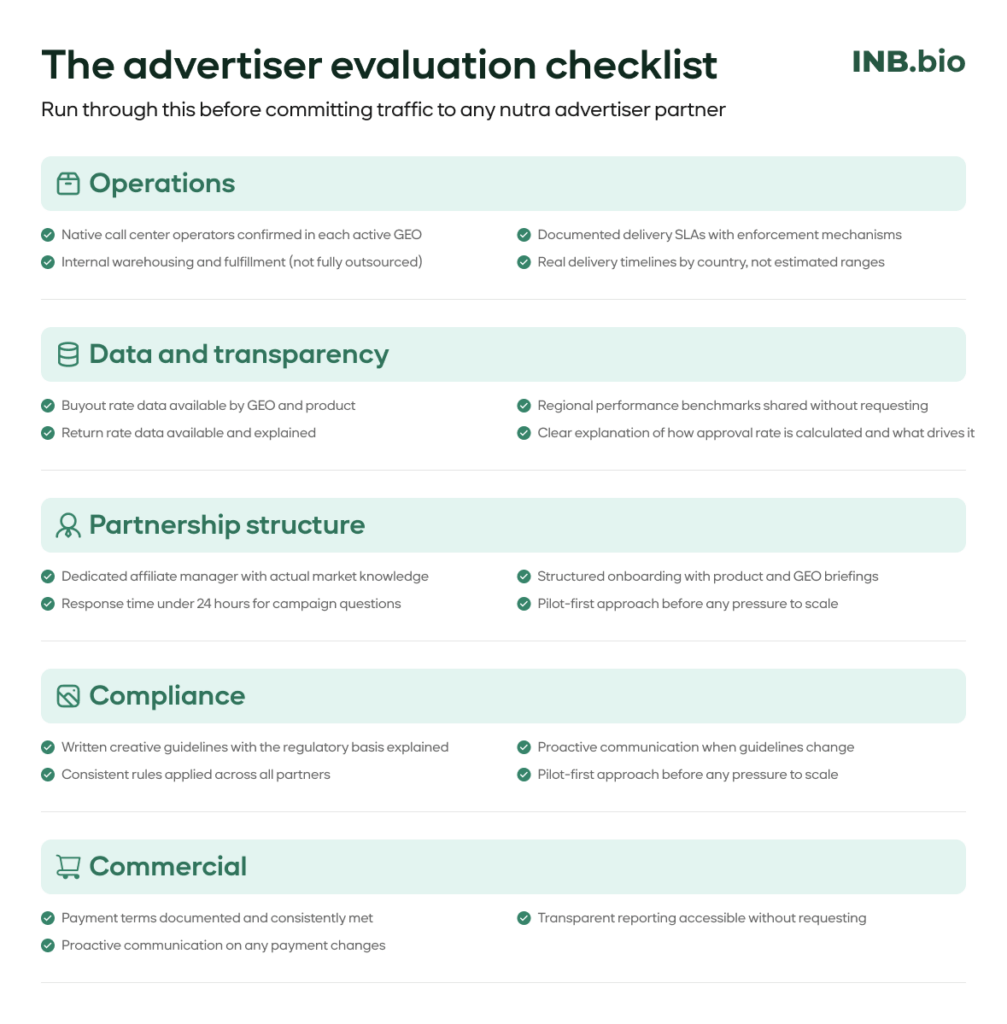
Run through this before committing traffic to any nutra advertiser partner:
Operations
Data and transparency
Partnership structure
Compliance
Commercial
The direct nutra advertiser partner you choose sets the ceiling on what your traffic can produce. You can optimize creative, refine targeting, and improve lead quality, but if the call center doesn’t convert, if delivery takes two weeks, or if the product isn’t adapted for the market, the ceiling stays low regardless.
“The best relationships we have are the ones where both sides treat results as a shared problem,” Yurii says. “The partner optimizes their traffic. We optimize our operations. Nobody points fingers when something dips, we diagnose it together and fix it. That’s what a real partnership looks like, and it’s the only kind that compounds over time.”
The green flags above describe what a partner who takes that responsibility seriously looks like. Yet, not every advertiser can answer all the questions in the checklist above. INB.bio can.
If you’re running traffic in exotic markets or looking for GEOs where the competition hasn’t caught up yet, talk to the INB.bio affiliate team.

A direct nutra advertiser owns and operates the products it promotes: handling production, call center operations, logistics, and delivery directly. A nutra network acts as an intermediary, connecting affiliates to offers from multiple advertisers without controlling the underlying operations.
Approval rate measures the percentage of leads who confirmed a purchase during the sales call. Buyout rate measures the percentage who actually paid when the courier arrived. In cash-on-delivery markets, the transaction is not complete until physical payment is made at the door approval is a commitment.
Ask for specifics at every operational level. Native call center: request the name of the team or vendor running operations and whether operators are native speakers. Warehouse: ask for the city location and average dispatch timeline. Delivery: ask for the logistics partners by name, their coverage areas, and what happens when a delivery attempt fails, who follows up, how many attempts are made, what the escalation process is. A direct advertiser with real infrastructure provides these details without hesitation because they are facts their operations team knows by default.
A pilot-first approach means launching a new GEO or product at controlled, limited volume, typically smaller lead batches, before scaling. The pilot period is used to monitor buyout rate, return rate, delivery performance, and partner feedback under real market conditions. Only after the product or GEO demonstrates stable performance across those metrics does volume increase. It matters because it protects both the partner and the advertiser from scaling bad fundamentals faster.